
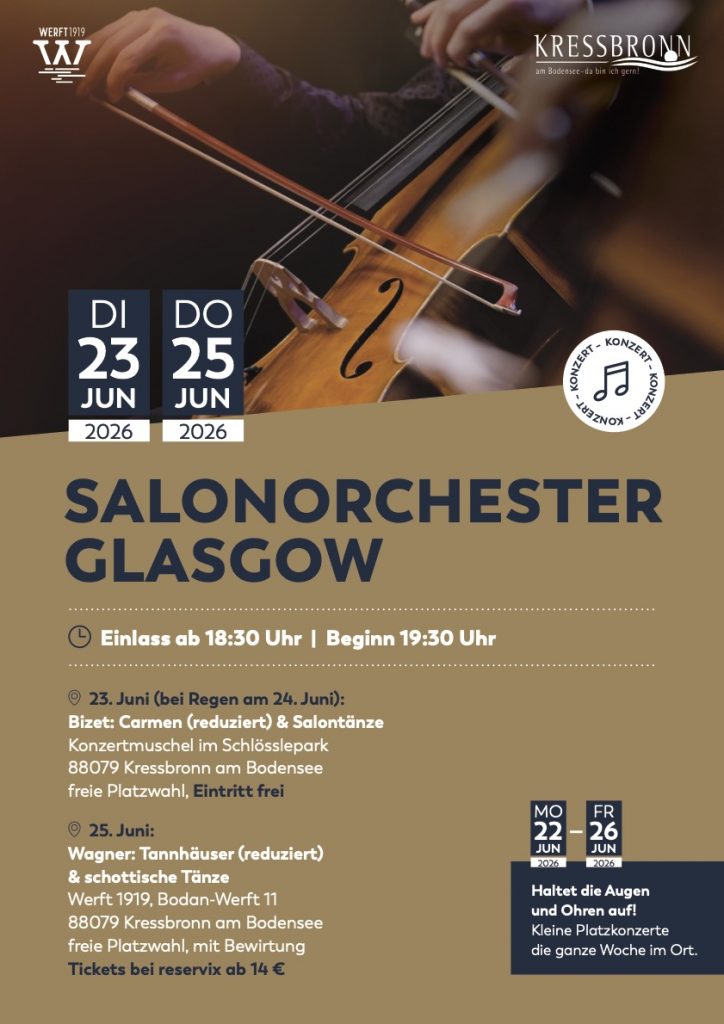
In June 2026, we’ll spend a week in Kressbronn am Bodensee. On Thursday, 25 June 2026, you can hear us on the lake stage (Werft1919) with Wagner’s Tannhäuser, Donizetti’s Lucia di Lammermoor as well as Meyerbeer’s torch dance No. 1 and a Ceilidh. A free pre-event takes place on 23 June in the music pavilion in Schlösslepark. Full programmes (English & German) below.
Mini-Festival: Große Oper, verkleinert
DEUTSCH: Das Salonorchester Glasgow besucht Kressbronn vom 22. bis 25. Juni 2026 mit einem besonderen Programm. Drei berühmte Opern werden in unterhaltsamen Kurzfassungen dargeboten: Bizets Carmen, Wagners Tannhäuser und Donizettis Lucia di Lammermoor (romantisches schottisches Melodrama). Ein alternatives Seefestival! Dazu wird schottisch getanzt.
Als Auftakt gibt es Carmen am 23. Juni in der Parkmuschel, umsonst und draußen (bei schlechtem Wetter am 24. Juni).
Am Donnerstag, den 25. Juni geht es in die Werft1919. Um den Bregenzern Konkurrenz zu machen, bringen die Schotten zwei Opern an einem Abend (Wagner und Donizetti), dazu einen Fackeltanz und einen Ceilidh zum Mitmachen.
Lassen Sie sich überraschen von Salon-Bearbeitungen aus der Zeit der Jahrhundertwende.
ENGLISH: The Glasgow Salon Orchestra will visit Kressbronn from June 22nd to 25th, 2026. Three famous operas will be performed in entertaining short versions: Bizet’s Carmen, Wagner’s Tannhäuser, and Donizetti’s Lucia di Lammermoor (a romantic melodrama set in Scotland).
The opening performance of Carmen will take place on Tuesday, June 23rd in the Konzertmuschel (park pavilion), free of charge and outdoors (in case of bad weather, on June 24th).
On Thursday, June 25th, the programme moves to the Werft1919 shipyard. To rival the Bregenz Festival, the Scots will present two operas in one evening (Wagner and Donizetti), along with a torch dance and a Ceilidh. Be surprised by salon arrangements from the turn of the 20th century and Scottish dancing for all.
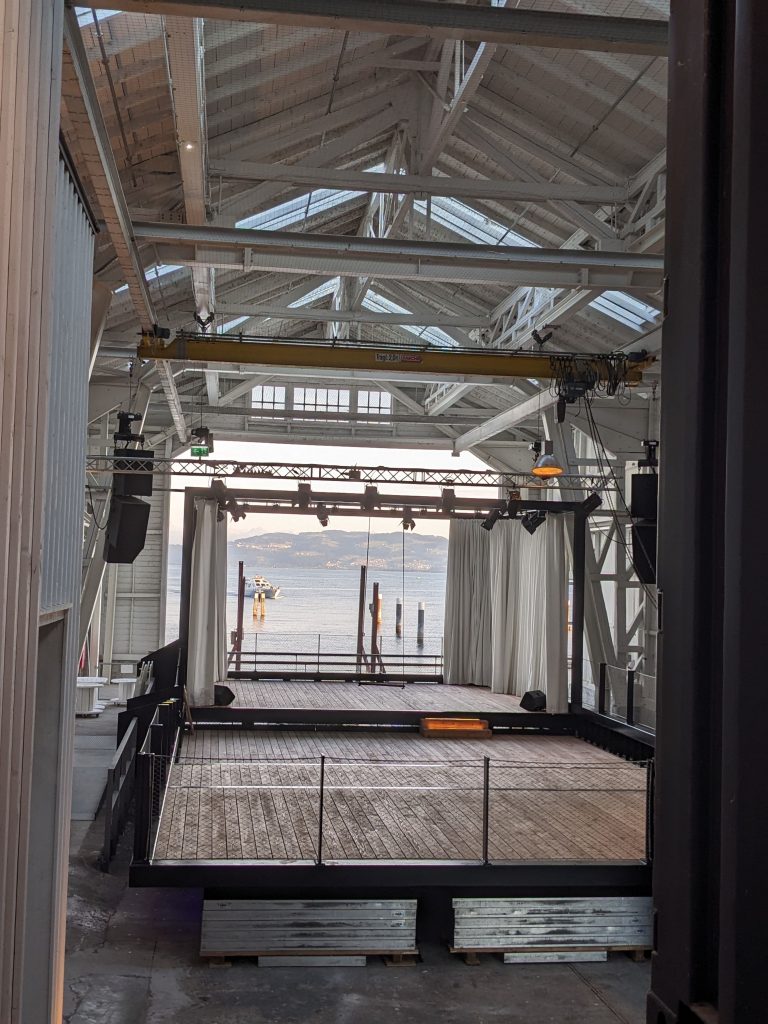
Kressbronn Seebühne Werft1919 (lake stage)
25 June 2026 (25. Juni 2026), 19:30 – 21:00
2 operas in one evening + torch dance and Ceilidh
Programme
Giacomo Meyerbeer (1844) / arr. Theodore Moses-Tobani (1889): Fackeltanz (torch dance) No. 1 B-flat major
ENGLISH: “The Marche Flambeaux was composed by Meyerbeer on the occasion of the betrothing of a Princess of Prussia. The composition of this kind of Morceau belongs to a ceremony of the Middle Ages, and is still observed in the German Courts. On the day of the betrothing of a prince or princess royal, it is the custom for each of the betrothed, with torch in hand, to make a tour of the salon several times, and to pass before the sovereign; the prince giving his hand to a lady, and the princess hers to a gentleman of the Court. All the guests follow the betrothed couple, who change partners each time until all present have walked around the room with them. The March is always in 3/4 time. It is a slow movement in the style of a polonaise, and scored for a military band.” [text from 19th piano arrangement published by Cramer, Beal & Co. London]
DEUTSCH: Der „Fackeltanz“ wurde von Meyerbeer anlässlich der Verlobung einer preußischen Prinzessin komponiert. Die Komposition eines solchen Marsches war ein mittelalterlicher Brauch und wird noch heute an deutschen Höfen gepflegt. Am Tag der Verlobung eines Prinzen oder einer Prinzessin ist es üblich, dass jeder der Verlobten mit einer Fackel in der Hand mehrmals durch den Salon und am König vorbeizieht; der Prinz gibt einer Dame die Hand, die Prinzessin einem Hofherrn. Alle Gäste folgen dem Brautpaar, das jedes Mal die Partner wechselt, bis alle Anwesenden einmal mit ihnen durch den Saal gegangen sind. Der Marsch steht stets im Dreivierteltakt. Es ist ein langsamer Satz im Stil einer Polonaise und für eine Militärkapelle gesetzt. [Vorwort einer Klavierbearbeitung des 19. Jahrhunderts, Verlag Cramer, Beal & Co., London]
Gaetano Donizetti (1835) / arr. Émile Tavan (1880s): Lucia di Lammermoor (Fantasie)
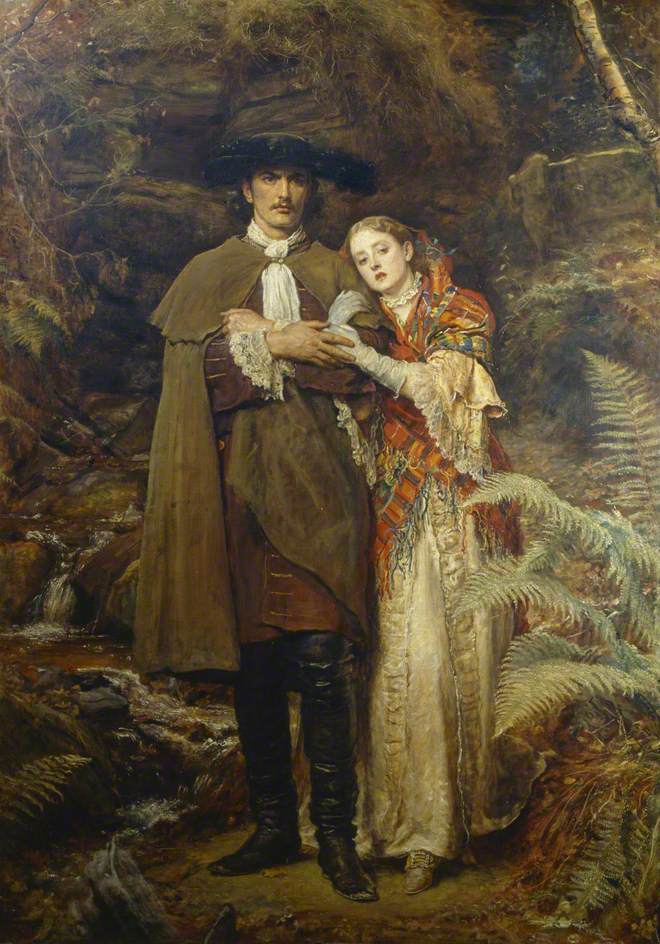
ENGLISH: Romeo & Juliet-type love and feud war in medieval Scotland
Lucia di Lammermoor tells the story of two young lovers from feuding families. The melodramatic plot unfolds at Ravenswood Castle in Scotland, based on Sir Walter Scott’s novel “The Bride of Lammermoor” (1819). In Donizetti’s opera, Lucia flees a wild bull and falls in love with her rescuer, Edgardo, from a rival clan. Lucia is then forced by her brother to marry the powerful Lord Arturo Buchan. She murders him on their wedding night and descends into madness.
DEUTSCH: Lucia di Lammermoor erzählt die Geschichte zweier junger Liebender aus verfeindeten Familien. Die melodramatische Handlung spielt auf Schloss Ravenswood in Schottland, basierend auf Sir Walter Scotts Roman „Die Braut von Lammermoor“ (1819). In Donizettis Oper flieht Lucia vor einem wilden Stier und verliebt sich in ihren Retter, Edgardo, aus einem verfehdeten Clan. Lucia wird dann von ihrem Bruder gezwungen, den mächtigen Lord Arturo Buchan zu heiraten. Lucia ermordet ihn in der Hochzeitsnacht und endet im Wahnsinn.
Richard Wagner (1845) / arr. Max Rhode (1923): Tannhäuser (Fantasie)
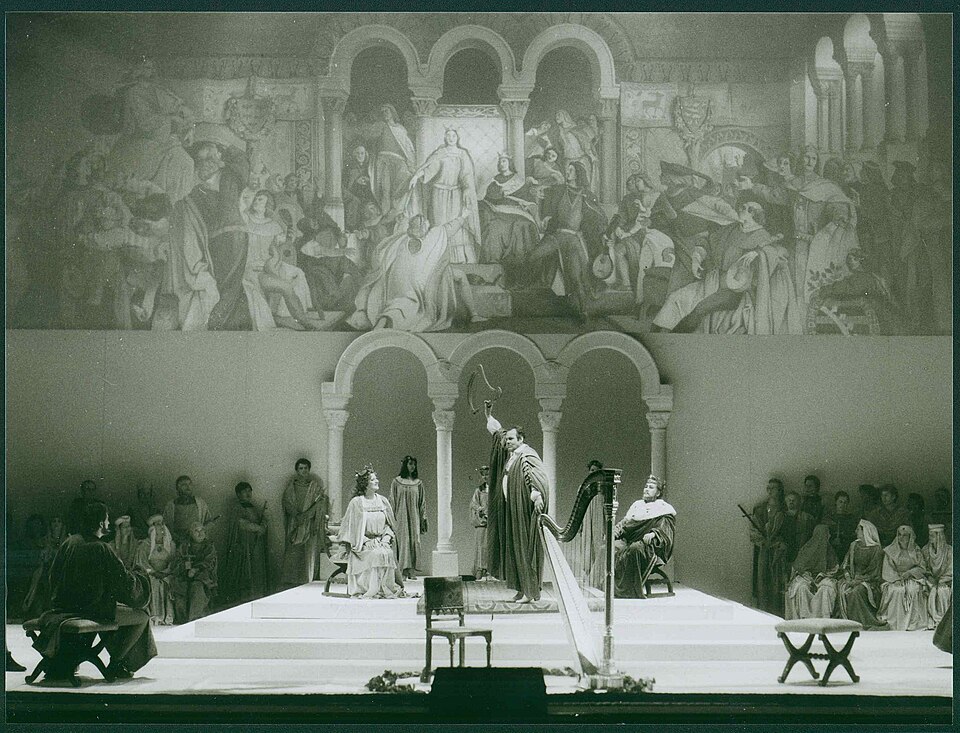
ENGLISH: medieval Minnesänger song contest, temptation of the Venus mountain
The knight Tannhäuser finds himself inside the Venusberg, a world of sensuality. He returns to Wartburg Castle, where he hopes to win the heart of Elisabeth, the Landgrave’s niece, in the Minnesingers’ competition. He sings a song about Venus, which reveals him as a sinner. On a pilgrimage to Rome, he seeks forgiveness in vain and finally finds redemption through Elisabeth’s purest love.
DEUTSCH: Der Ritter Tannhäuser findet sich im Inneren des Venusberges, einer Welt der Sinnlichkeit. Er kehrt zur Wartburg zurück, wo er im Wettbewerb der Minnesänger das Herz Elisabeths, der Nichte des Landgrafen, gewinnen will. Er singt ein Lied von Venus, was ihn als Sünder offenbart. In einer Pilgerfahrt nach Rom sucht er vergeblich um Vergebung und findet schließlich Erlösung durch Elisabeths reinste Liebe.
[interval, chairs removed / Stühle werden entfernt]
Ceilidh: Eightsome Reel & more
DEUTSCH: Tanzen wie die Schotten. Ein Ceilidh (ausgesprochen „kay-lee“) ist eine schottische Zusammenkunft. Ein „Caller“ sagt Tanzschritte an. Es wird in Gruppen, Paaren oder Reihen zu traditioneller Folk-Musik getanzt. Jeder kann mitmachen. Schottenrock erlaubt.
Tickets: 14,00 € available via reservix:
https://www.reservix.de/kressbronn-am-bodensee/venue/werft1919/v41722
Carmen in the Park (Konzertmuschel, Schlösslepark)
23 June 2026 (23. Juni 2026), 19:30 – 20:30
Taster programme (free and outdoors; if bad weather, postponed to 24 June)
Programme
Queen Mary, Road to Dundee, In Praise of Islay (traditional Scottish melodies)
Georges Bizet: Carmen (1875) arr. Schreiner/Weninger (1928)
Dimitri Schostakowitsch – Valtz II Nr. 2 from Jazz-Suite (1955)
Gerardo Matos Rodriguez – La Cumparsita (Tango) (1916)
George Gershwin – Nice work if you can get it (Medium quick step) (1937)
Paul Desmond / Brubeck quartet / arr. Greenslade: Take 5 (5/4) (1959)
Dizzy Gillespie / Frank Paparelli: A Night in Tunesia (Samba) (1944)
Irving Berlin – Steppin’ out with my baby (1947)
Richard Rodgers / arr. Spud Murphy: The Blue Room (foxtrot) (1926 / 1935)
Athol Highlanders (traditional Scottish dances)
Salonorchester Glasgow:

Gabriel Doucet (violin)
Shona MacLeod (violin)
Gabriel Reinés March (violin)
Martin Kretschmer (viola)
Elizabeth Porter (cello)
Lynette Eaton (double bass)
Sophia Duncan (flute)
Stephen Webster (clarinet/saxophone)
Sharon Kretschmer (trumpet)
Bob Whitney (tuba)
 with special guests:
Charlotte Kawohl (percussion)
Maurizio Reyes (piano)
Friedemann Kawohl (harmonium)
