
Wagner’s Tannhäuser in 17 minutes. This post presents a full live recording of Max Rhode’s (1923) Fantasie for Salon orchestra of Richard Wagner’s Oper. We also assembled excerpts from two other rare Salon pieces: Meyerbeer’s Fackeltanz (torch dance) No. 1 (arranged 1889 by Theodore Moses-Tobani) and Donizetti’s Lucia di Lammermoor (arranged ca. 1880 by Émile Tavan).
Lucia (1835), Fackeltanz (1844) and Tannhäuser (1845) were originally composed within the same (pre-revolutionary) decade. There are subtle connections. For example, in the early 1840s Wagner prepared a piano vocal score and various instrumental arrangements of Donizetti’s opera La favorita, and Meyerbeer was an early supporter of Wagner. The three Salon arrangements offer different styles, ranging from a flamboyant theatre orchestra to more symphonic ambitions, reinventing the operatic drama.
All three pieces were performed by us on 25 June 2026 at the former Kressbronn shipyard Werft1919. To our knowledge, these are world first recordings.
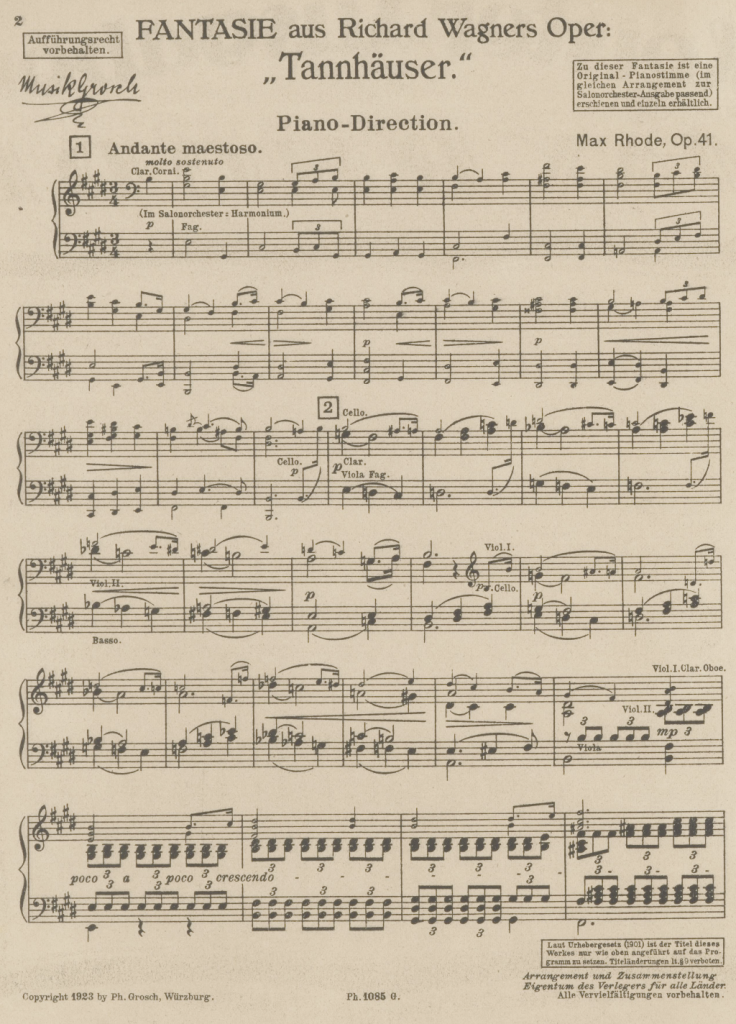
Max Rhode (1884 – 1945) was trained as a trombonist, and in demand as a composer and arranger of over 900 character pieces, intermezzi and fantasies from operas and operettas. The publisher Grosch advertised Rhode’s Salon series as “Meister Ausgaben” (master editions) and “unübertroffen” (never bettered). Rhode’s version of Tannhäuser (1923) indeed combines a powerful dramatic structure with sophisticated colouring (enhanced by the use of a harmonium and various percussion instruments).
Wagner’s stage directions for the first Act of Tannhäuser (Venusberg) say: “Im fernsten sichtbaren Hintergrunde dehnt sich ein bläulicher See aus; in ihm erblickt man die badenden Gestalten von Najaden; auf seinen erhöhten Ufer-Vorsprüngen sind Sirenen gelagert.” (In the farthest visible background, a bluish lake stretches out; one glimpses the bathing figures of Naiads, while Sirens recline on its raised rocky promontories.)
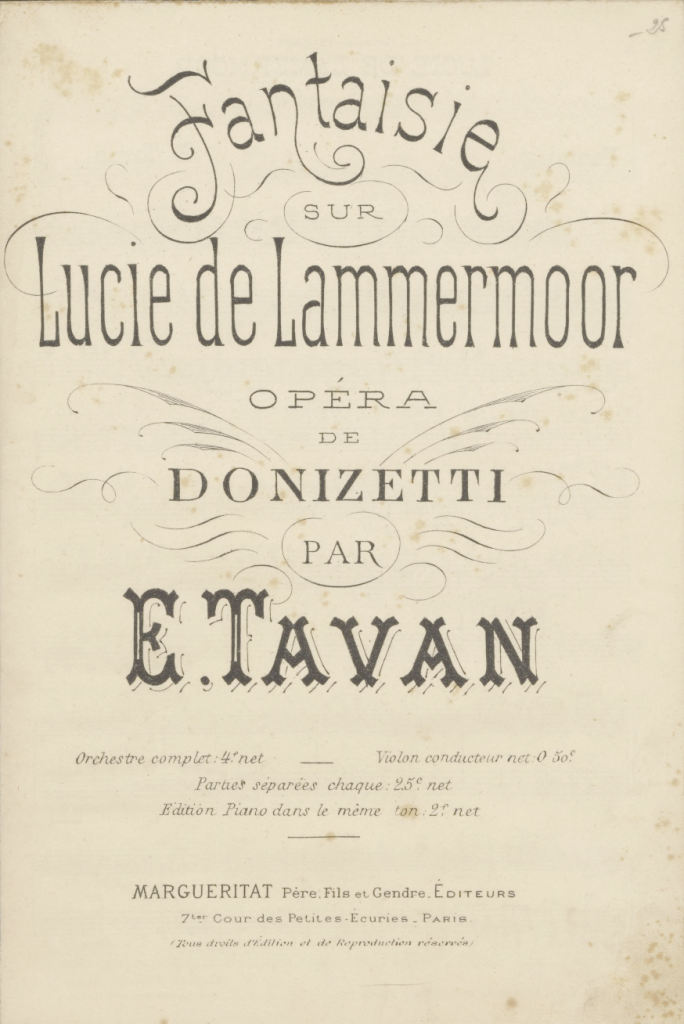
Gaetano Donizetti (1797 – 1848) was regarded in his time as the most important composer of Italian bel canto. Visiting Paris in 1835, he experienced Giacomo Meyerbeer’s grand opéra style, with massive crowd scenes and historico-political plots. Lucia di Lammermoor was written soon after and included compelling set pieces, such as Lucia’s forced marriage sextet Chi mi frena in tal momento? (Who stops me at such a moment?, the second number in our recorded excerpts).
Lucia di Lammermoor, and in particular the Chi mi frena sextet, became immensely popular and central to 19th century musical consciousness. Franz Liszt immediately turned it into his Réminiscences de Lucia di Lammermoor (1835/6). Multiple arrangements circulated widely, such as Émile Tavan’s orchestral Salon version (ca. 1880).
Giacomo Meyerbeer (1791-1864) today is often viewed through the lens of Richard Wagner (1818-1883), who framed Meyerbeer’s music as superficial and incoherent (most notoriously in his antisemitic essay Das Judenthum in der Musik, published under Wagner’s own name only after Meyerbeer’s death).
Meyerbeer’s career was split between roles as Kapellmeister for the Prussian Court from 1832 and grand opéra commissions for Paris. It is less known that Meyerbeer had provided recommendations for Wagner’s early engagements. Wagner also spent an impoverished period in Paris (1839-1842) during Meyerbeer’s peak popularity there (after Wagner had become insolvent while opera director in Riga).
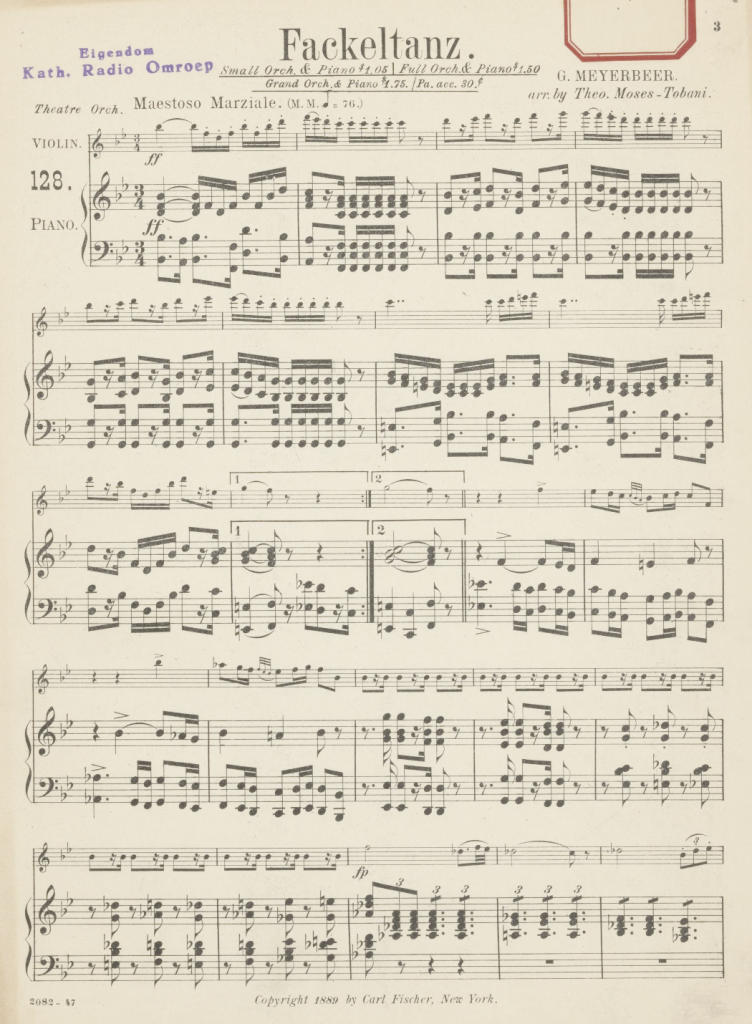
Meyerbeer’s Fackeltanz (torch dance) was characterised by contemporaries as follows: “The Marche Flambeaux was composed by Meyerbeer on the occasion of the betrothing of a Princess of Prussia. The composition of this kind of Morceau belongs to a ceremony of the Middle Ages, and is still observed in the German Courts. On the day of the betrothing of a prince or princess royal, it is the custom for each of the betrothed, with torch in hand, to make a tour of the salon several times, and to pass before the sovereign; the prince giving his hand to a lady, and the princess hers to a gentleman of the Court. All the guests follow the betrothed couple, who change partners each time until all present have walked around the room with them. The March is always in 3/4 time. It is a slow movement in the style of a polonaise, and scored for a military band.” [preface from a piano arrangement published by Cramer, Beal & Co. London]
Performers: Salonorchester Glasgow
Gabriel Doucet (violin)
Shona MacLeod (violin)
Gabriel Reinés March (violin)
Martin Kretschmer (viola)
Elizabeth Porter (cello)
Lynette Eaton (double bass)
Sophia Duncan (flute)
Stephen Webster (clarinet/saxophone)
Sharon Kretschmer (trumpet)
Bob Whitney (tuba)
 with special guests:
Charlotte Kawohl (percussion)
Maurizio Reyes (piano)
Friedemann Kawohl (harmonium)
Further background to our Salon project can be found here. We also have recorded Salon arrangements of Bellini’s Norma, Mozart’s Zauberflöte, Mascagni’s Intermezzo from Cavalleria rusticana and Tchaikovsky’s Natha-Valse. https://salonorchester.net/recordings-released-on-youtube/
